South-East Governors United Behind President Tinubu – Umahi Urges Obi to Join,
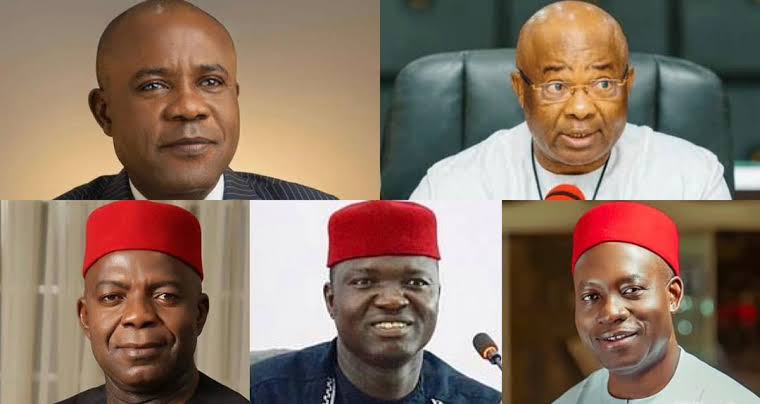
The Minister of Works, Senator David Umahi, has revealed that every governor in Nigeria’s South‑East is now firmly aligned behind President Bola Ahmed Tinubu. He made the disclosure during a feature interview for an upcoming State House documentary marking the President’s second year in office.
Umahi lauded the new spirit of cooperation sweeping through the region, stressing that partisan boundaries have given way to a common determination to secure federal investment and accelerate development. “All the governors in the South‑East, irrespective of their party lines, are working closely with President Tinubu,” he said. “This administration is addressing decades‑old complaints of marginalisation, and for the first time we’re seeing tangible action instead of promises.”
Highlighting specific federal projects, the minister listed the Port Harcourt–Enugu Road, the Enugu–Abakaliki Highway, the Enugu–Onitsha Expressway, and the ongoing Second Niger Bridge—which has already received 30 percent of its total funding. Umahi described these schemes as concrete proof that “fairness and equal treatment across all zones” are finally being delivered.
Plans are now under way for a regional summit that will draw political, traditional, and business leaders from the South‑East to issue a formal endorsement of President Tinubu’s 2027 re‑election bid. Umahi urged former Anambra governor and Labour Party presidential candidate Peter Obi to attend. “Leadership is not about ego or rivalry—it is about the people,” he insisted. “If someone is doing what you hoped to do for your people, support him.”
Beyond politics, Umahi provided fresh updates on four transformative infrastructure corridors nationwide. Chief among them is the Lagos–Calabar Coastal Highway—a 700‑kilometre concrete‑paved super‑route envisaged to link nine coastal states, stimulate trade, and spur tourism. Section 1, stretching 47.47 kilometres from Ahmadu Bello Way to Eleko Junction, is more than 80 percent complete; Section 2, running 55 kilometres to the Lagos–Ogun border, is advancing rapidly. Thirty kilometres of Section 1 have already been delivered, with an additional ten nearing completion in Section 2.
“By December, we will begin tolling Section 1,” the minister revealed. “The road is far more than asphalt and concrete—it is an economic corridor fitted with solar lighting, CCTV surveillance, and embedded climate‑resilient features that will earn carbon credits.” Government projections foresee a ten‑year return on investment, driven by increased port activity, inter‑state commerce, and real‑estate growth along the corridor.
Construction has also commenced on Sections 3 and 3B—65 kilometres spanning Cross River and Akwa Ibom—while preliminary works continue on the Sokoto–Badagry Superhighway and the historic Trans‑Saharan Trade Route. “Concepts once sketched during colonial times or the Shehu Shagari era are now being built in real time,” Umahi noted. “President Tinubu’s commitment is turning dormant dreams into live assets.”
Economic analysts say the combined projects could add up to 2 percent to national GDP by 2030, create an estimated 400,000 direct and indirect jobs, and boost Nigeria’s competitiveness within the African Continental Free Trade Area (AfCFTA). Umahi echoed those forecasts, predicting new industrial clusters near the Lekki Deep Sea Port, expanded agro‑processing zones in Cross River, and revived inland markets along the Sokoto–Badagry axis.
Industry stakeholders have likewise welcomed the renewed federal focus. The President of the Manufacturers Association of Nigeria, Otunba Francis Meshioye, stated that reliable trunk‑A highways could slash logistics costs by up to 35 percent and help local goods compete more effectively under AfCFTA rules. Civil‑society groups such as the Road‑Users Network have praised the switch to closed‑loop electronic tolling, arguing that it will improve transparency, cut travel times, and reduce carbon emissions by eliminating long queues at toll plazas.
On the issue of community engagement, the Minister disclosed that host settlements are being consulted on compensation, resettlement, and the establishment of vocational centres. “Infrastructure must lift the people it touches,” he said. “Beyond concrete and steel, these roads will bring clinics, schools, and ICT hubs that anchor inclusive growth.”
He further revealed that the Ministry is partnering with local universities to create internship pipelines, enabling engineering students from the South‑East to gain hands‑on experience at project sites. “We want our young talents to build their future on foundations they helped lay,” Umahi explained, adding that the initiative aligns with the Federal Government’s Renewed Hope agenda for youth empowerment.
In closing, Umahi paid tribute to what he called President Tinubu’s “strategic foresight and uncompromising focus on execution.” The projects, he asserted, are “economically viable, environmentally sustainable, and socially transformative—proof that Nigeria can build boldly for the benefit of every citizen.”
About the Author