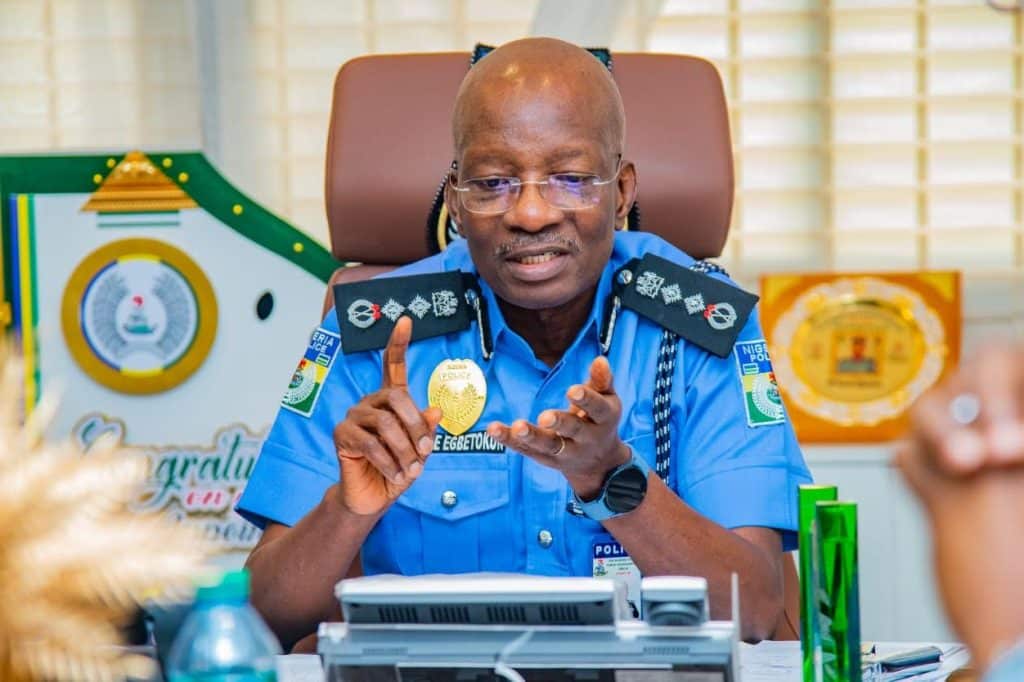
The Inspector-General of Police, Kayode Egbetokun, has placed a spotlight on police accountability after ordering a “full-scale, transparent investigation” into the death of 14-year-old Kehinde Alade, who was struck by a stray bullet in Ibadan on his way to write the ongoing West African Senior School Certificate Examination (WASSCE). Alade’s death on Tuesday sent shock waves through Oyo State, where parents and neighbours watched in disbelief as the teenager—dressed in uniform and reportedly revising chemistry notes—was fatally hit while travelling with his father to the examination centre. The officer who discharged the round has already been taken into custody as detectives from the Force Criminal Investigation Department move to reconstruct the incident and determine culpability.
Initial police reports suggest the bullet was fired during an attempt by traffic officers and a patrol team to stop Kehinde’s father for an alleged traffic violation near the busy Gbagi–Alakia corridor of Ibadan. Oyo State Command officials later claimed the senior Alade had tried to evade arrest—a claim the bereaved parent has neither denied nor confirmed publicly. Eyewitnesses told local media that a single shot ricocheted off the road surface before piercing the vehicle’s rear window and hitting Kehinde in the neck. He died minutes later, transforming a routine school run into a tragedy that has reignited debate over trigger discipline and crowd-control training among Nigerian police ranks.
In a statement issued by Force Public Relations Officer Olumuyiwa Adejobi, the IGP condemned the shooting, promised that “no stone will be left unturned,” and vowed to publish the investigation’s findings to maintain public trust. The police chief also conveyed his “heartfelt condolences” to the Alade family and urged residents to remain calm while the inquiry runs its course. Rights advocates, however, have already called for an independent coroner’s inquest, arguing that internal investigations seldom lead to convictions and that the victim’s young age demands exemplary justice.
The timing has added poignancy: WASSCE is viewed nationwide as a critical gateway to higher education, and candidates often endure months of late-night study to prepare. Kehinde’s classmates at Champion Comprehensive High School in Ibadan held a candle-light vigil on Wednesday evening, displaying his unused exam slip and placards that read “Books Not Bullets” and “WHO Protects the Children?” Teachers at the school reported that several students were too traumatised to sit Wednesday’s English paper.
While the force grapples with the fallout in Oyo, another crisis brewed hundreds of kilometres away. On Monday, officers of the Force Intelligence Department’s Intelligence Response Team (FID-IRT) were ambushed by a mob on the Benin–Ore expressway near the University of Benin (UNIBEN) in Edo State’s Okhuimwun Community. According to police, commuters had blocked the highway over unrelated grievances and turned on the plain-clothes operatives, pelting them with stones, sticks and iron rods. Two officers sustained head wounds, yet the unit “exercised commendable restraint” by refraining from firing live rounds at the crowd, the force headquarters said.
Although both incidents differ in origin, they converge on a single concern: the growing volatility of police-citizen encounters. The IGP warned that the Edo assault would not go unpunished and cautioned against “acts of lawlessness and unprovoked aggression” toward personnel who are “duty-bound to maintain public order.” Investigators are compiling video footage from motorists’ dashcams and roadside stores to identify attackers, and prosecutors are expected to file charges ranging from attempted murder to destruction of public property.
Security analysts say the dual crises could prove an inflection point for the Egbetokun leadership. “What Nigerians want is not rhetoric but measurable reform—body-cams, non-lethal options, stronger community oversight,” noted Dr. Funke Ojo, a criminology lecturer at the University of Lagos. She argues that recovering public confidence hinges on swift, transparent justice in the Alade case and a visible crackdown on mob violence in Edo.
For now, the police hierarchy has promised openness. A high-level investigative panel comprising homicide detectives, ballistics experts and human-rights monitors is expected to submit a preliminary report within two weeks. The findings—if published in full—could set a new precedent for transparency in Nigeria’s law-enforcement history. Until then, Kehinde Alade’s classmates will sit their remaining papers with an empty desk in the front row—a stark reminder of the human cost when public safety mechanisms fail.
About the Author