
Warheads raining down from space, hypersonic cruise missiles striking US infrastructure, and massive nuclear blasts high in the atmosphere — these are some of the alarming scenarios experts warn could happen if America’s outdated defense systems are overwhelmed in a future high-tech attack.
Even a single, relatively small nuclear blast hundreds of miles above the US could trigger an electromagnetic pulse (EMP) with devastating effects. Such an EMP would cause planes to drop from the sky and disable everything from phones and medical devices to water supplies.
What is the ‘Golden Dome’?
The US government has introduced an ambitious new missile defense project called the “Golden Dome.” While still in the early planning stages, the system aims to create multiple defense layers across land, sea, and space, including space-based sensors and interceptors.
Defence Secretary Pete Hegseth said the system would intercept missiles launched from anywhere in the world — even from space. President Trump added that parts of the program would be based in states like Florida, Indiana, and Alaska.
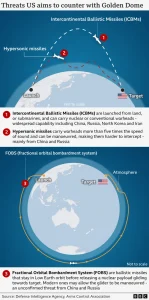
The Golden Dome will build on existing missile defense systems designed mainly to stop traditional intercontinental ballistic missiles (ICBMs). The new system would also tackle cruise missiles and other advanced threats by detecting and intercepting them at various flight stages.
Currently, the US relies mostly on 44 ground-based interceptors in Alaska and California, which are meant to counter limited missile attacks. Experts warn these systems are not enough to defend against large arsenals from Russia or China.
How does it compare to Israel’s Iron Dome?
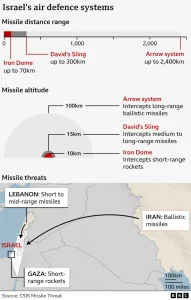
President Trump first mentioned the Golden Dome in March, referencing Israel’s Iron Dome missile defense system. Israel’s system is effective against short-range threats like rockets fired from Gaza but does not cover long-range missiles.
The Golden Dome aims to cover those longer-range threats, combining multiple capabilities into one integrated defense network. However, experts note that a unified command system to coordinate such diverse defenses doesn’t exist yet.
Can it be built?
Building the Golden Dome will be extremely complex and expensive. Trump suggested it could be completed by the end of his term, with a total cost of $175 billion, including an initial $25 billion investment. However, estimates from the Congressional Budget Office put the price at over $500 billion for space-based components alone, making it one of the most costly defense projects ever.
Experts warn rushing the project could lead to costly mistakes and delays. Integrating multiple new technologies is difficult, and failures are likely along the way.
Concerns and strategic impact
The project has raised concerns about a new arms race, with rivals like China warning it could turn space into a battlefield. Still, some US defense experts argue the Golden Dome is necessary to shift the strategic balance, deterring potential attackers by making missile strikes much harder.
Even a partially completed Golden Dome could prevent catastrophic attacks, offering greater peace of mind to Americans.
Expert Take:
William Fortschen, a weapons researcher, warned, “It’s not about going back 100 years. We’d lose everything and might have to rebuild civilization from scratch.” The Golden Dome aims to prevent exactly that.
Patrycja Bazylczyk, a missile defense expert, said the project represents a new approach to counter advanced weapons like hypersonic missiles and orbital bombardment systems that Russia and China are developing. “Our adversaries have long-range strike capabilities unlike what we’ve faced before,” she explained.
About the Author