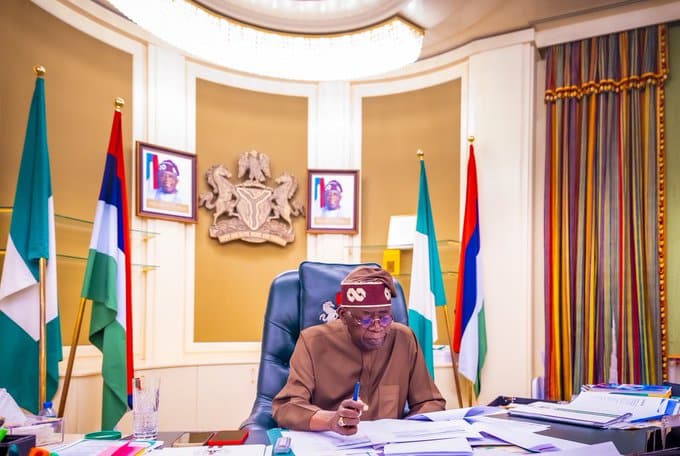
President Bola Ahmed Tinubu on Monday held key meetings at the State House, Abuja, including a high-level session with the Chairman of the Federal Inland Revenue Service (FIRS), Zacch Adedeji.
The meeting followed a controversial move by the Federal Capital Territory Administration (FCTA), which sealed off the FIRS headquarters in Zone 5, Abuja. The FCTA claimed the action was due to an alleged failure to pay ground rent for 25 years.
FIRS Labels FCTA Action as “Unprofessional”
The closure of one of Nigeria’s top federal institutions quickly drew strong criticism. The FIRS described the sealing of its office as “malicious” and “unprofessional.” The agency expressed its concerns through social media and official statements, arguing that the action was both unjustified and damaging to public trust.
Arabirin Aderonke Atoyebi, Technical Assistant on Broadcast Media to the FIRS Chairman, accused the FCTA, led by Minister Nyesom Wike, of acting in bad faith. She said the move undermines institutional cooperation and could negatively affect the agency’s operations.
FIRS Denies Allegations of Debt
According to the FIRS, the claims of unpaid ground rent are false. The agency insisted that the land in question is legally held by the federal government and does not require rent in the same way private property does. They also stated that there were ongoing discussions to clarify the status of the property before the FCTA took enforcement action.
The FIRS stressed that such drastic actions should follow legal procedures, not public confrontation, especially when they involve critical institutions responsible for revenue generation.
FCTA Defends Its Action
On the other hand, the FCTA argued that the FIRS office had defaulted on ground rent for over two decades. A senior official, speaking anonymously, stated that no institution is exempt from land-use regulations. He noted that the government has been firm in recovering unpaid rents from both private and public bodies.
The sealing of the FIRS office was part of a broader enforcement effort. The FCTA recently launched a campaign targeting nearly 5,000 properties in Abuja with unpaid ground rent, as part of its strategy to recover over ₦39 billion in arrears.
President Tinubu Steps In
President Tinubu’s meeting with the FIRS Chairman is widely seen as a move to de-escalate the conflict. Insiders at the Presidency say Tinubu is focused on maintaining inter-agency cooperation while still upholding accountability and the rule of law.
The President also met with the Minister of Solid Minerals Development, Dele Alake, and the Minister of Budget and National Planning, Atiku Bagudu, on related economic matters. Although full details were not disclosed, the meetings are believed to be connected to broader fiscal reforms and government revenue targets.
Reactions from the Public and Experts
The incident has drawn mixed reactions. Some Abuja residents praised the FCTA for enforcing property laws without bias. They believe all property holders, including government agencies, should be held accountable.
However, others criticized the public nature of the dispute, warning that such actions could undermine trust in public institutions. Legal experts say that although the FCTA may have the legal right to enforce rent payments, disputes involving federal agencies should be resolved through structured dialogue.
Civil society groups have also weighed in. Dr. Halima Yusuf, from the Abuja Policy Forum, said the issue reveals poor coordination between government bodies. She called for clear legal frameworks and better inter-agency communication to prevent future conflicts.
What Happens Next?
Following the President’s intervention, affected property owners, including FIRS, have been given a 14-day grace period to clear all outstanding ground rent and penalties or risk permanent revocation.
This includes anyone who has failed to obtain the Minister’s Consent or register their property titles. The FCTA has warned that there will be no further extensions after the deadline.
Conclusion
The FIRS ground rent dispute has become a test of President Tinubu’s leadership style—balancing firmness with fairness. While the FCTA insists on full compliance, the President’s goal appears to be restoring order and ensuring that due process is followed.
Whether this dispute ends in harmony or further tension will depend on how both agencies respond in the days ahead.
About the Author